TL;DR
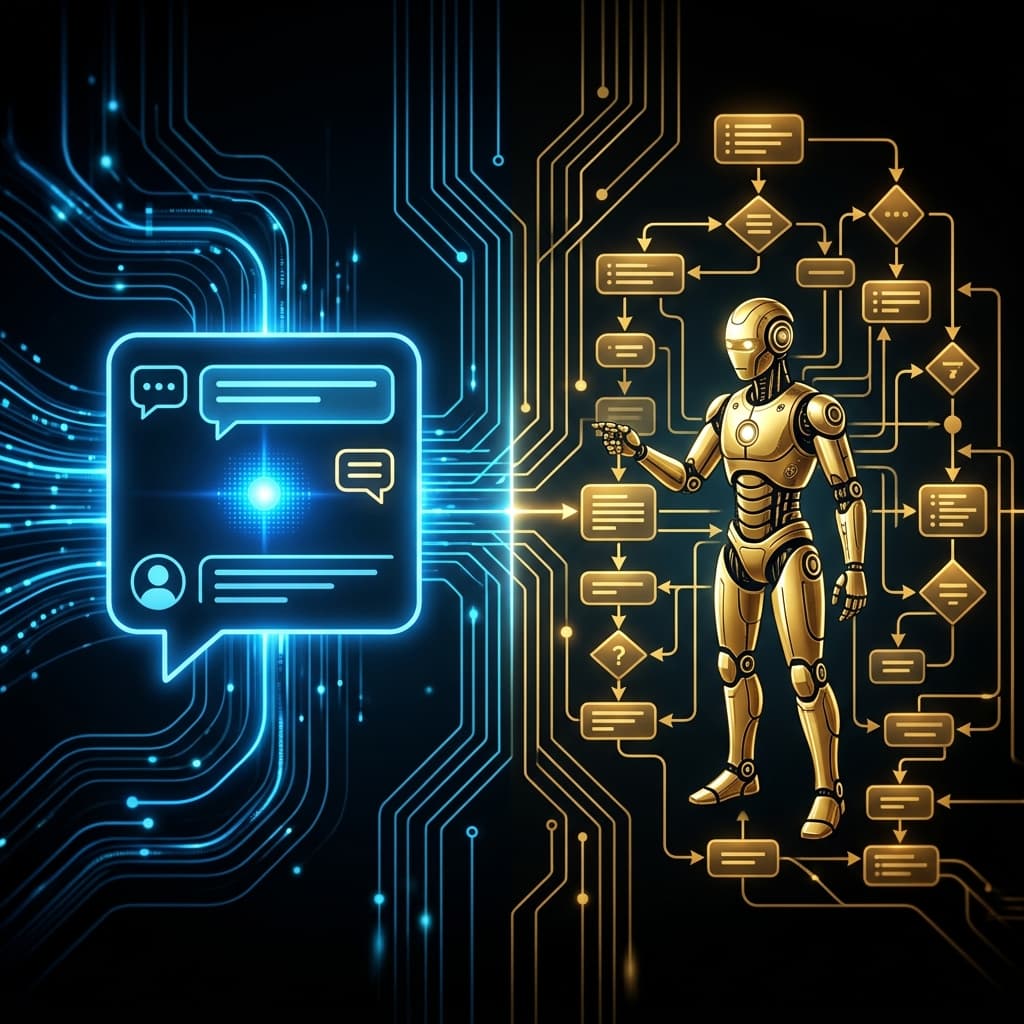
Chatbots handle conversations. AI Agentscomplete work. If you need better customer Q&A, start with a chatbot. If you need to automate entire business workflows with AI automation, invest in an AI agent.
What Is an AI Chatbot?
An AI chatbot is a conversational system designed to answer questions, provide information, and assist users through text or voice interactions. Modern chatbots use natural language processing (NLP) to understand intent and respond naturally — but their core job is communication, not execution.
Chatbots excel at handling high-volume, predictable conversations that follow repeatable patterns — freeing support teams from answering the same questions hundreds of times a day.
Typical Chatbot Use Cases
What Is an AI Agent?
An AI agent goes far beyond conversation. Instead of only answering questions, an AI agent can understand goals, make autonomous decisions, perform tasks across multiple applications, and complete entire workflows with minimal human intervention.
Think of an AI agent as a digital employeerather than a digital receptionist — it doesn't just respond, it acts.
What AI Agents Can Do
Side-by-Side Comparison
| Feature | AI Chatbot | AI Agent |
|---|---|---|
| Primary Role | Conversation | Task Execution |
| Learns Context | Limited | Extensive |
| Integrations | Basic | Advanced (CRM, ERP, APIs) |
| Decision Making | Limited / Scripted | Autonomous |
| Workflow Automation | Minimal | End-to-End |
| Multi-Step Tasks | Rare | Native capability |
| Setup Complexity | Low | Medium–High |
| Business Impact | Customer support | Ops-wide automation |
How to Choose the Right Solution
Choose a Chatbot if…
Choose an AI Agent if…
Industry Use Cases
Both chatbots and AI agents play different roles across industries. Here's how leading sectors are deploying each:
Healthcare
Chatbot
- Answer patient FAQs
- Appointment reminders
- Symptom triage
AI Agent
- Schedule & reschedule appointments
- Update EHR records
- Auto-generate clinical notes
Retail & E-Commerce
Chatbot
- Order tracking queries
- Return policy FAQs
- Product questions
AI Agent
- Manage inventory levels
- Process returns end-to-end
- Personalised reorder automation
Finance
Chatbot
- Balance inquiries
- FAQ on products
- Branch locator
AI Agent
- Invoice processing
- Expense approval workflows
- Fraud alert triage
Manufacturing
Chatbot
- Shift scheduling FAQs
- Safety protocol queries
AI Agent
- Predictive maintenance alerts
- Production report generation
- Quality inspection logging
Education
Chatbot
- Course information
- Admissions FAQs
- Campus queries
AI Agent
- Student progress tracking
- Auto-generate reports
- Course recommendation engine
Benefits at a Glance
AI Chatbot Benefits
AI Agent Benefits
Common Mistakes Businesses Make
Choosing a chatbot when workflow automation is needed
If your problem is 'we spend 20 hours/week on manual data entry', a chatbot won't solve it. That's an AI agent problem.
Expecting AI to fix broken business processes
AI agents automate processes — they amplify whatever is already there. Fix the process first, then automate it.
Deploying without clear success metrics
Define your KPIs before launch: response time, tickets resolved, cost per interaction, hours saved per week.
Skipping employee training and change management
Resistance from teams is the #1 cause of AI project failure. Involve people early and frame AI as removing burden, not roles.
Failing to integrate AI with existing systems
An AI that can't access your CRM, ERP, or email is severely limited. Integration is not optional — it's the core value driver.
Frequently Asked Questions
Can an AI chatbot become an AI agent?
Some advanced platforms combine conversational interfaces with workflow automation, allowing chatbots to trigger agent-like actions. However, true AI agents have independent reasoning and multi-system execution capabilities that go far beyond a typical chatbot.
Are AI agents more expensive than chatbots?
AI agents often require more integration and configuration, but they deliver significantly higher long-term ROI by automating complex, multi-step processes. The investment typically pays back within 6–12 months for well-scoped projects.
Can small businesses use AI agents?
Yes. Many modern AI platforms are suitable for startups and SMEs, allowing businesses to automate repetitive work without enterprise-scale budgets. Starting with one focused use case is the recommended approach.
Do AI agents replace employees?
Their primary role is to automate repetitive tasks, enabling employees to focus on strategic, creative, and customer-facing work. Most organizations redeploy rather than reduce headcount after deploying AI agents.
Which is better for SEO and lead generation — chatbot or agent?
A chatbot is generally more relevant for lead generation (capturing visitor intent, qualifying leads in real-time). AI agents are better for nurturing and processing those leads through your CRM and follow-up sequences.
Final Thoughts
AI chatbots and AI agents both have an important place in modern businesses — but they solve different problems. The mistake most companies make is choosing one without a clear view of what problem they're actually solving.
If your goal is better customer conversations, a chatbot is a strong, cost-effective choice. If your goal is automating entire business workflows and improving operational efficiency, AI agents provide significantly broader and more transformative capabilities.
The best solution always depends on your business objectives, existing processes, and growth plans. When in doubt, start small, prove ROI, and scale.
Let Optivra Help You Decide
Optivra helps startups, SMEs, and enterprises implement AI automation solutionstailored to their business goals — from intelligent chatbots to advanced AI agents, workflow automation, custom software, ERP, and CRM solutions. Book a free consultation today.